

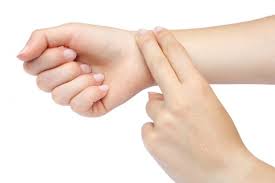
 1.Record your resting heart rate.
Ideally do this before you get out of bed in the morning, or after you have been sat or lying down for at least 10 mins.
Your resting heart rate (RHR) represents the number of times your heart beats each minute when you are at rest. Since a strong cardiovascular system allows your heart to pump more blood with every beat, a lower RHR tends to correspond with higher aerobic fitness (for example, cyclist Lance Armstrong’s RHR was allegedly only 32 beats per minute at the peak of his fitness).
To measure your RHR, place two fingers on your wrist, below the thumb, to locate the radial pulse, and then count the number of beats you feel in 60 seconds. You should count the first beat as ‘zero’. Do this first thing in the morning before you get up or eat/drink anything or do any exercise.
 2.Step Test
Equipment needed: Stopwatch or clock with a second hand; a friend to help you keep count; a 12-inch bench, box, or step; a metronome (if you don't have one, use the free online version at www.MetronomeOnline.com)
Goal: Step on and off the bench for 3 minutes straight while keeping a consistent pace and then see how quickly your heart rate will come back down.
Execution: This test is based on a 12-inch step, so use one as close to 12 inches as possible. Set the metronome to 96 beats per minute and make sure you can hear the beat. Stand facing the step. When ready to begin, start the clock or stopwatch and march up and down on the step to the metronome beat (up, up, down, down) for 3 consecutive minutes. (You can rest if you need to, but remain standing.) When 3 minutes are up, stop immediately, sit down on the step, and count (or have a friend count) your pulse (use your wrist or neck) for one full minute. Rest for another minute and record your heart rate again for a minute.
What this measures: This test assesses your fitness level based on how quickly your heart rate recovers after exercise. The fitter you are, the quicker your heart rate will return to normal after exercise.
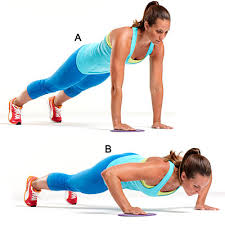 3. Push up Test
Technically, this test measures muscular endurance rather than pure strength, as it is based on how many you can do in a fixed period of time rather than how much weight you can lift – but it is still a respectable measure of upper-body brawn. Push-ups challenge the chest, shoulder and upper arm muscles – and require good core stability.
How to do this exercise
Push ups
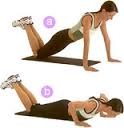 Assume a push-up position (if you can’t do any push-ups, then assume a modified position with your knees on the floor). Each repetition must be executed with good technique: the body should remain in a straight line, the head should be in line with the spine, and the arms should bend to at least 90 degrees.
Record how many you can do in one minute.
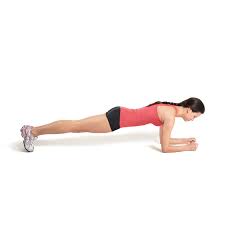 4.Plank
Lie on your stomach with your forearms on the floor, elbows directly under your shoulders, fists facing each other. Tighten your core muscles, curl your toes under, then press down through your forearms and extend your legs to lift your body. Your head, neck, back and legs should form a straight line (like a plank of wood). Look at the floor. Hold for as long as possible.
Record how long you lasted.
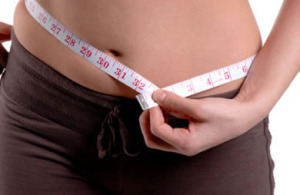 5. Measure yourself.
Using body measurements is one of the best ways to see how your body is changing.
Use a soft tape measure to take readings
around the mid point ( half way between your knee and hip) of your thigh,
the largest part around your hips
The largest part around your waist,
and the mid point around your upper arm.
It is often an idea to take these measurement 2 or 3 times to get an average and avoid any false measurements.